
 by John Parkins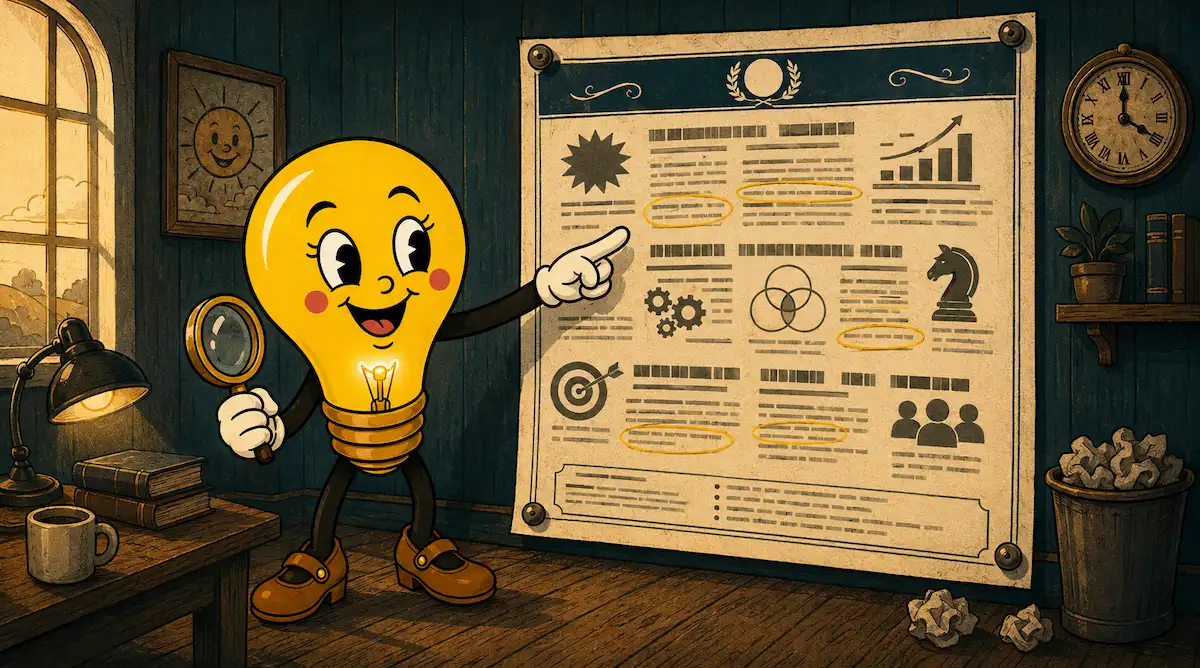
Marketing quotes are full of words designed to make you feel like asking a follow-up question is a bad idea. Words like omnichannel. Words like engagement uplift. Words like brand activation, which usually just means we will print a banner and post a few times. If you have read a proposal twice and still cannot tell what you are paying for, the problem is the proposal, not you.
So here is the bottom line, up top. You do not need to learn the jargon to read a marketing quote. You need to ignore most of it and ask three plain questions. A proposal is just a list of work somebody wants to do for you, with a price on it. That is the whole thing. Everything else is decoration, and some of the decoration is there to keep you from looking too hard at the rest.
The cost of nodding along is real. Sign something you do not understand and one of two things happens. You pay for work that never gets measured, so a year later nobody can tell you whether it did anything. Or you pay a premium for plain work wearing expensive clothes. I write these proposals for a living, so I will let you in on the part both the good ones and the bad ones know: the words are the easy part. Here is how to read past them.
What is the proposal actually measuring?
Look for what gets measured, not what gets promised.
Promises are cheap to write. Lines like we will grow your brand awareness or we will boost engagement read great and prove nothing, because there is no number attached to either one. A real deliverable has an edge you can check. Five hundred postcards mailed by the fifteenth. A new homepage live by March. A monthly report that shows calls, clicks, or walk-ins. If a line on the quote cannot be checked off as done or not done, it is a hope, and you should not pay hope prices for it.
Who is actually going to do the work?
Find the person whose hands will be on your account, not the list of platforms.
A proposal can name ten channels and still skip the one thing that matters, which is who is behind the keyboard. Is it the person sitting across from you, a junior nobody mentioned, or a contractor three time zones away you will never meet? Good shops are happy to tell you. Ask to meet the people who will touch your account. If the answer gets vague, that vagueness is the answer.
What do you do about all the buzzwords?
Ask whoever wrote it to define one out loud, and watch what happens.
Call it the synergy test. Pick the fanciest word in the document and ask, in a friendly voice, what does that mean for my business exactly? Somebody who understands the work will explain it in about ten seconds. Somebody hiding behind the word will hand you a longer version of the same word. You are not being difficult. You are checking whether there is a real thing under the language, and you have every right to know.
The 60-second proposal check
Run this before you sign anything.
- Circle every promise. Next to each one, write the number that would prove it happened. No number means you are paying for a wish.
- Find the name of the actual person who will do the work, not just the agency.
- Read it out loud to your spouse or your bookkeeper. Anywhere they stop you to ask what a word means, that word is hiding something.
- Add up only the line items you understand. If that is most of the total, good. If half the money is going to things you cannot explain, slow down.
- Ask what happens if it does not work. The answer tells you how confident they really are.
If a proposal cannot survive being read by somebody who is not in the marketing business, it is not a good proposal yet. It does not matter how much research went into it.
Read enough of these and the good ones start to look alike. Plain language. Clear numbers. A real name attached to the work. When your quote looks like that, you can finally tell whether the money did anything, which was the point the whole time.
If you have a quote in front of you that you cannot make sense of, that is the kind of thing I am happy to sit down and read through with you. No pressure, and no decoder ring required. I will tell you what it actually says.
A few questions I get
Is a longer, more detailed proposal a better one?
Not by itself. Length is sometimes a way to make a small amount of work look like a lot, or to bury the price down on page six. Judge a proposal by how much of it you can understand, not by how much of it there is.
What if I ask what a term means and they make me feel dumb for asking?
That reaction is your answer. The right shop wants you to understand what you are buying, because a client who gets it tends to stick around. Anybody who makes you feel small for asking a fair question is showing you how the rest of the relationship will go.
Who can help me make sense of a marketing quote near me?
Any honest local shop should be willing to read one with you, even a competitor's. If you are in Lima or anywhere in Northwest Ohio, the Brain Squad at BeyondVivid does exactly this, in plain English and with no sales pitch, because the thinking behind a quote is the part most owners never get shown.